
Pilkin ICE Fish 7–60g: How to Choose the Right Weight
Seven grams and sixty grams. In a photograph they still look like the same silver baitfish with a single treble hook, yet on the water they are two completely different tools. A light Pilkin can be allowed to fall slowly along a perch-holding drop-off, while the 60 g version can maintain contact during light boat jigging, in a Norwegian fjord or when the drift starts to pick up.
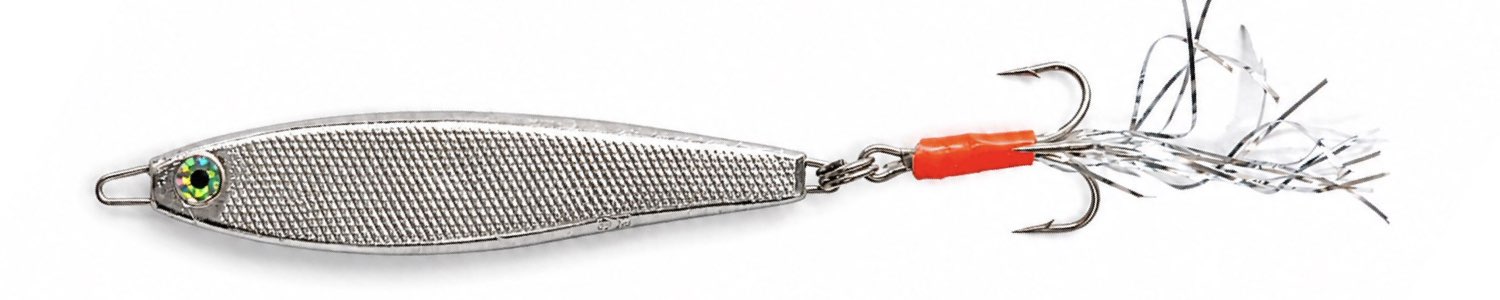
Pilkin ICE Fish is exactly the sort of lure that can look almost too simple at first glance. It has no diving lip, no soft tail and none of the complex balancing found in a hard bait. What it does have is a compact metal body, a baitfish profile, a silver finish and one treble hook. That simplicity allows it to work in several very different situations – from light freshwater spinning, through long casts for asp and vertical zander fishing, all the way to light saltwater jigging.
The range contains seven weights: 7, 10, 16, 20, 25, 40 and 60 g. They should not be selected by target species alone. The same perch may be feeding half a metre below the surface in a sheltered bay or holding deep beneath a boat in the wind. Asp may hunt close to the bank or far beyond a current seam. At sea, depth is only part of the equation; drift speed, current and the amount of line in the water matter just as much. Choosing the right weight is therefore always a balance between finesse and control.
Why such a simple metal lure can work in so many ways
The Pilkin has an elongated baitfish silhouette, a broader head section with an eye, a tapered tail and a scale-like surface pattern. In the water it does not look like a shapeless piece of metal. When retrieved, turned or allowed to fall, it shows its flanks and produces short flashes. It is not an exact imitation of one species. It sends the more general signal of a small prey fish that has left the shoal, changed direction or briefly lost its balance.
In freshwater, the profile may suggest a young bleak, roach or another small silver baitfish. At sea, the same silhouette can resemble a small herring, sprat or another slender prey fish. Predators rarely need a lure to be a perfect copy of one species. They react to profile size, speed, flash, direction changes and, above all, the moment when the lure no longer appears fully stable.
The silver finish works by reflecting light. During a faster retrieve it flashes briefly like the flank of an escaping baitfish; during a turn it exposes a larger reflective surface, and on the fall the intensity of that flash keeps changing. In clearer water and daylight, the signal is often more visible. In coloured water or at greater depth, colour alone is not enough, and retrieve speed, depth and accurate lure placement become more important.
The Pilkin also does not rely on the broad side-to-side swing of a traditional spoon. Its movement comes mainly from what the angler does with the rod and reel. On a steady retrieve it suggests a baitfish trying to escape. When the pace is reduced, it shows its side; during a pause it begins to fall; and after being lifted from the bottom it accelerates again. Its greatest strength is therefore not one fixed action, but the ability to alternate speed, direction and a controlled fall.
Pilkin, pirk or pilker?
The words pirk and pilker are used as general names for metal lures and this style of fishing, especially at sea. Pilkin, in this case, is the specific name of the compact ICE Fish product family. This is why we classify these products under the lure type Pilkin. When discussing the technique in general, terms such as pirk fishing, vertical jigging and shore jigging make sense. When discussing this particular family, we use the name Pilkin ICE Fish.
One family, three very different roles
The lightest branch, Pilkin ICE Fish with treble hook 7–16 g, is designed mainly for light freshwater spinning. The 7 g version gives the most delicate fall, 10 g is a versatile light starting point, and 16 g adds casting distance and control in wind or a mild current. Perch is the main target, although zander may also take it close to the bottom or during vertical work. An active asp may notice the smaller Pilkin as well, but the middle range gives more reserve for deliberate long-range fishing.
Pilkin ICE Fish with treble hook 20–25 g combines a small baitfish silhouette with longer casting and firmer contact. The 20 g version feels livelier and falls a little more slowly. The 25 g version adds reserve against wind, current and faster drift. This pair has a clear role in active asp fishing, but it also works for vertical perch and zander fishing from a boat, kayak or belly boat.
The heaviest branch, Pilkin ICE Fish with treble hook 40–60 g, is aimed primarily at saltwater use. The 40 g version suits shallower areas, weaker current and slower drift where a livelier presentation is still possible. The 60 g version reaches the working depth faster and holds contact better in wind, current or a quicker-moving boat. These are still light saltwater weights, however, not universal deep-water pirks for every Norwegian condition.
How to choose between 7, 10, 16, 20, 25, 40 and 60 g
The table below is not a rigid depth chart. The same 20 g Pilkin may feel unnecessarily heavy in a sheltered bay and far too light in current on a long line. Use it as a starting map, then confirm the choice by asking whether you can genuinely feel the lure and control its fall.
| Weight | What to expect | Typical use | Treble hook | Product range |
|---|---|---|---|---|
| 7 g | The most delicate presentation and slowest fall in the range. | Shallow calm water, light perch spinning and situations where the lure should not rush towards the bottom. | Size #10 | Pilkin 7–16 g |
| 10 g | A balanced mix of finesse, casting distance and control. | General light perch spinning, shallow to medium depth and a sensible first choice in unfamiliar conditions. | Size #8 | Pilkin 7–16 g |
| 16 g | Longer casting, a quicker fall and better contact. | Greater depth, wind, mild current and distant drop-offs where 7 or 10 g becomes difficult to read. | Size #6 | Pilkin 7–16 g |
| 20 g | A lively middle-weight option with useful casting range. | Long casts for asp, deeper freshwater and lighter vertical fishing for perch or zander. | Size #4 | Pilkin 20–25 g |
| 25 g | More reserve against wind, current and drift. | Longer casts, faster returns to depth and vertical work when 20 g starts to move away from the intended line. | Size #4 | Pilkin 20–25 g |
| 40 g | A livelier light-saltwater Pilkin. | Shore jigging, harbours, shallow fjords, weaker current and slower drift where a longer fall remains useful. | Size #2 | Pilkin 40–60 g |
| 60 g | A faster descent, greater reach and firmer contact. | Greater depth, stronger current, faster drift and situations where the lure needs to stay closer beneath the boat. | Size #1 | Pilkin 40–60 g |
The most important rule fits into one sentence: use the lightest weight that still reaches the required layer, remains clearly detectable and allows you to control the fall. Move up when the Pilkin becomes difficult to read. Move back down when it falls unnecessarily fast and the whole presentation loses finesse.
Weight should not be chosen by species alone
Depth determines how long the Pilkin takes to reach the working layer. Current changes its path and may carry it away from the fish. Wind creates a bow in the line and weakens contact even when the water itself appears calm. From a boat, drift adds another force. The same weight can therefore behave very differently during a single day, even when the target species and location do not change.
A lighter Pilkin extends the falling phase and allows a more delicate presentation. A heavier version reaches the fish sooner, holds its line better and is less affected by current. That does not mean the heaviest option should be selected automatically. An unnecessarily heavy lure may fall too hard, pass through the active layer too quickly and reduce the sensitivity of the whole setup.
Casting distance matters as well. A compact metal body travels well, but every additional metre puts more line between the rod and the lure. That reduces sensitivity and increases the effect of wind. When fishing for asp, the goal is not simply to cast as far as possible. It is more important to place the Pilkin beyond the activity or current seam, then retrieve it at the correct speed through the area where the fish are feeding.
How to work a Pilkin so it does not remain just a piece of metal
The simplest starting point is a steady retrieve. After the cast, allow the Pilkin to reach the chosen layer and begin winding at a consistent pace. For perch, it can be worked more slowly and deeper. For active asp, it can be retrieved faster and higher in the water column. When fish do not respond, do not change the lure immediately; first change the speed or depth.
A short change of pace can be highly effective. Several faster turns of the reel increase the flash and suggest escaping prey. Slowing down afterwards lets the Pilkin show its flank and lose stability. The transition between speed and deceleration may be more convincing to a predator than constant aggressive rod work.
When fishing the fall, allow the lure to descend without giving it completely slack line. Watch the direction and speed of the line. A take does not always arrive as a hard knock. Sometimes the fall simply stops, the line goes slack or moves sideways. Near the bottom, use shorter pauses and remember that a single treble hook can find gaps between rocks or catch an edge.
Vertical fishing from a boat, kayak or belly boat does not require large lifts. Often it is enough to raise the Pilkin a short distance, let it fall again and keep it inside the working layer. If drift carries it too far away from the craft, harder rod movements are not the answer. Shorten the line, change the angle or move to a heavier weight.
Perch, asp, zander and saltwater fishing: where each range makes the most sense
Perch is the main freshwater target for the light group. Start with 7 or 10 g in shallow, calm water. The 16 g version adds reach and control in wind or a mild current. If the fish are deep beneath the boat and drift carries the light Pilkin away, 20 or 25 g may be more practical. Fish drop-offs, rocky shelves, harbour walls, the edges of baitfish shoals and the water directly beneath the craft.
Asp is most naturally matched with the 20–25 g group. The small metal profile casts well and produces short silver flashes during a faster retrieve. The 20 g version feels livelier, while 25 g adds reserve against wind and current. A 16 g Pilkin can still work in calm conditions, but the middle range offers more confidence for deliberate long-range fishing.
Zander may respond close to the bottom, during the fall or on a vertical presentation. In shallower, calmer water, 10–16 g can be enough. For greater depth, wind or drift, 20–25 g is often more practical. The key is maintaining contact during the descent and recognising the moment when the lure's movement changes.
At sea, the 40–60 g range takes over. The 40 g version suits shallower areas, harbours, rocky edges, shore jigging and slower drift. The 60 g version adds a faster descent and firmer contact. In northern waters, the small silver profile can attract cod, saithe, pollack and mackerel. If even 60 g cannot hold the intended line and the braid develops a large bow, it is time to move to the heavier Pilker ICE Fish NOR.
Rod, braid, leader and treble hook
One setup cannot handle 7 and 60 g equally well. With the light range, sensitivity and the ability to read the fall are the priorities. With 20–25 g, the rod also needs a safe reserve for longer casts and work from a boat. With 40–60 g, it must cope with repeated saltwater loading, shore jigging or vertical fishing. The casting rating must always cover the Pilkin and the rest of the rig with a safe margin.
Thin braid improves contact and reduces water resistance, but its diameter must suit the target fish, obstacles and style of fishing. Thicker line creates a larger bow and may force the use of a heavier lure. Choose the leader according to water clarity, abrasion and bite-off risk. Where pike are present, use material suited to that risk. At sea, pay close attention to the abrasion resistance of every connection and to the effects of saltwater.
Every weight is supplied with one treble hook. According to the supplier catalogue, the 7 g version uses size #10, 10 g uses #8, 16 g uses #6, both 20 and 25 g use #4, 40 g uses #2 and 60 g uses #1. Before fishing, check hook sharpness, the split ring and the free movement of the hook. After saltwater use, rinse the Pilkin in fresh water and allow it to dry completely.
Frequently asked questions – Pilkin ICE Fish 7–60 g
Is Pilkin ICE Fish only intended for saltwater fishing?
No. The 7–16 g and 20–25 g ranges are highly usable in freshwater for perch, zander, asp and vertical fishing. The 40–60 g range is designed mainly for light saltwater jigging, shore jigging and Norway.
Which weight should I choose for perch?
Start with 7 or 10 g in shallower, calmer water. The 16 g version adds casting distance and control in wind or mild current. For deeper vertical fishing from a boat, 20 or 25 g may be more suitable.
Which weight should I choose for asp?
For deliberate long casts and faster retrieves, start with the 20–25 g group. The 20 g version is livelier, while 25 g provides more reserve in wind and current. A 16 g Pilkin can also work in calm conditions.
Can Pilkin be used for zander?
Yes, especially close to the bottom and during vertical fishing. In shallower water, 10–16 g may be enough. In deeper water, wind or drift, 20–25 g is often more practical. Maintaining contact through the fall is essential.
Are 40 or 60 g heavy enough for Norway?
Yes, for lighter jigging, shallower fjord areas, weak to moderate current and slower drift. In deep water, strong current or fast drift, both may be too light; in those conditions, choose a heavier Norwegian pirk.
What does the silver Pilkin imitate?
It is not an exact copy of one species. In freshwater, it creates the general profile of a young bleak, roach or another small silver baitfish. At sea, it may resemble a small herring, sprat or similar prey.
Do takes come during the retrieve or on the fall?
Both are possible. Active asp may strike during a fast retrieve, while perch or zander often react to a change of pace, a lift from the bottom or the descent. Keep watching the line during every pause.
What is the difference between a Pilkin and a pirk?
Pirk or pilker is a general term for a metal lure and the fishing method. Pilkin is the specific name of this compact ICE Fish product family, which is why SAF treats it as a separate lure type.
How should I care for a Pilkin after fishing?
After every session, check the treble hook, split ring and body finish. After saltwater use, rinse the lure in fresh water, allow it to dry completely and replace any damaged or corroded components before the next trip.
Summary
Pilkin ICE Fish is not one lure offered in seven random weights. It is a family that begins with a delicate perch presentation and ends with light saltwater jigging. The 7 g version offers maximum finesse, 10 g versatility and 16 g greater reach and control. The 20 and 25 g options open the door to asp fishing and deeper vertical work. The 40 and 60 g versions move the same compact profile into saltwater, fjords and faster drift.
The best weight is not automatically the heaviest one. It is the weight that reaches the correct layer, still allows you to feel the lure and lets you recognise a change when a fish takes. Once that principle becomes clear, there is no need to memorise rigid depth charts. Watch the water, the braid and what the lure transmits back through the rod.
→ Pilkin ICE Fish with treble hook 7–16 g for light freshwater spinning, perch and a more delicate fall.
→ Pilkin ICE Fish with treble hook 20–25 g for longer casts, asp and vertical perch or zander fishing.
→ Pilkin ICE Fish with treble hook 40–60 g for light saltwater jigging, shore jigging and Norwegian fjords.
→ Find the whole family in the Small Saltwater Metal Jigs category. For greater depth and stronger current, continue to the Pilker ICE Fish NOR range.
Prepared by Filip Souček, SAF Crew. The recommendations are based on the construction of the complete range, supplier catalogue data and practical selection according to depth, current, wind, drift, casting distance and retrieve style.