
Jig hooks
Jig hooks for casting your own jig heads should be selected according to geometry, lure size and the specific mold – not only by the weight of the finished head. SAF offers 60° and 90° jig hooks from VMC, Gamakatsu and Eagle Claw, from fine freshwater sizes through reinforced and Fireball designs to large hooks for saltwater jigs.
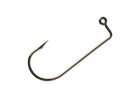
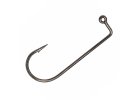
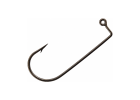
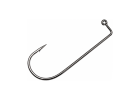


Product sorting
Brands
List of products




A jig hook is the structural foundation of your own jig head. When choosing one, consider hook size, shank length, bend shape and gap, wire diameter, eye position and compatibility with the specific mold. Only then does it make sense to decide on the finished head weight, surface finish and freshwater or saltwater use.
Do not choose hook size according to jig-head weight. The hook must primarily rig the soft plastic lure correctly. Check the hook-point exit position, the length of the solid section of the bait and the amount of free space inside the bend. Jig-head weight should then be matched to depth, current, drift, required rate of fall and presentation style.
The same correctly rigged soft plastic lure can therefore be used with several different jig-head weights. In shallower water or with a slower presentation, a lighter head may be enough, while greater depth and stronger current can require a significantly heavier one. Changing jig-head weight alone is not a reason to automatically move to a longer or larger hook.
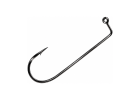
90° jig hooks – classic jig heads; VMC 5150, VMC 9147, Eagle Claw 570B and Gamakatsu JIG.
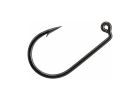
60° jig hooks – different pull point; for example VMC 7161 BN and saltwater VMC 6198 TI.
Short Shank / Fireball – compact hooks for Fireball rigs, such as VMC 7154 BN.
Heavy saltwater – robust hooks for heavy saltwater jigs, such as VMC 6169 BN.
A 60° or 90° designation describes the position of the front section of the hook and eye in relation to the shank. It affects the point through which line or leader tension acts on the jig head. The final position and action of the lure, however, are created by the combination of head shape and weight, soft plastic lure, current and presentation – the hook angle alone does not determine how the finished jig behaves.
Shank length is also important. A longer shank places the hook point farther into the front or middle section of the soft plastic lure. A shorter Short Shank leaves more of the lure free to move and is used in designs that should remain compact. A hook that is too long can restrict the rear section of the lure, while one that is too short may position the point unnecessarily far forward.
With deeper and wider shads, also check the hook gap. Enough free space must remain between the lure body and the hook point for a reliable hook-up. Two soft plastic lures of the same length may therefore require different hook sizes because of differences in body depth, width or the length of the solid front section.
Select wire diameter and hook strength according to the type of rig. Finer Aberdeen hooks make sense for lighter jig heads and smaller lures, while reinforced 2X Strong or Heavy constructions provide more strength reserve under higher loads. Heavier wire, however, also changes hook dimensions and the way the hook fits inside the mold.
Numerical hook size is not a universal dimensional standard across manufacturers or individual series. A VMC 3/0, Gamakatsu 3/0 and Eagle Claw 3/0 may therefore differ in shank length, bend width, wire diameter and eye position. Whenever you change hook model or brand, check the actual dimensions and fit in both the lure and the mold.
The same rule applies to hooks with the same eye angle. Two models marked 90° can differ significantly in geometry, wire diameter, bend shape or eye size. You should never assume that a hook of the same numerical size from another series will fit the same mold.
When casting your own jig heads, always place the exact hook size into the selected mold cavity before adding lead. The shank and eye must sit correctly in the prepared grooves and both halves of the mold must close completely without placing pressure on the hook. Compatibility listed for one size must not be automatically transferred to another size or another cavity of the same mold.
For individual products and molds on SAF, we list specifically verified combinations wherever we have confirmed them. This is more accurate than a general statement that a particular model “fits a 90° mold” or “works with all jig heads”. Before producing a larger batch, we recommend casting one test piece and checking hook position, eye clearance and correct rigging of the intended soft plastic lure.
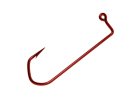
Surface finish should always be considered together with the intended use of the specific hook series. Our range includes Black Nickel, Nickel, NS Black, red RD and tinned TI finishes. Finish colour alone does not define hook construction or saltwater suitability; for saltwater use, follow the intended application of the exact hook series and rinse finished jigs with fresh water after fishing.
For regular saltwater fishing, choose the hook not only according to lure size but also according to the load placed on the complete rig. Large jig heads, deep water and strong drift may require a much more robust construction than standard freshwater spinning. On the other hand, an unnecessarily heavy hook on a small soft bait can change the proportions of the rig and restrict its natural movement.
SAF subcategories are therefore not divided only by brand. Series such as VMC 5150, 7161, 6198, 9147, 6169 and 7154, Eagle Claw 570B and Gamakatsu JIG 22 or JIG 90 represent different geometries and applications. Other specialised VMC series also have their own construction and should always be selected according to the specific lure and mold.
If you already know the lure, start by choosing the correct shank length and hook bend. If you already have the mold, start with its list of compatible hook models and sizes. Only then choose the required jig-head weight, finish and pack size for production.
Frequently asked questions – jig hooks
How do I choose the correct jig hook size?
Place the hook directly alongside the soft plastic lure and check the shank length, hook-point exit position, body depth and free space inside the bend. The active rear section of the lure should remain sufficiently free to move.
Does jig-head weight determine hook size?
No. Hook size should primarily match the lure and the required rigging. Jig-head weight should be selected according to depth, current, drift, rate of fall and presentation style.
What is the difference between a 60° and 90° jig hook?
The difference is the position of the front section and eye in relation to the shank. This changes the point through which leader tension acts on the jig head. The final behaviour of the rig is also influenced by head shape, lure and presentation.
Does every 90° hook fit every 90° jig mold?
No. The same eye angle does not guarantee the same shank length, wire diameter, bend shape or eye position and size. Always verify the exact hook model and size directly in the mold.
Are hook sizes the same across all manufacturers?
No. The same numerical size may have different actual dimensions across manufacturers or hook series. When changing model, check the lure fit and mold compatibility again.
When should I choose a Short Shank hook?
A short shank is used in compact designs such as Fireball heads, where the hook is not intended to run a long distance through the body of a soft plastic lure.
When do I need a reinforced or Heavy jig hook?
A stronger construction may be suitable for higher loads, larger lures or heavy saltwater setups. Always match hook strength to the intended application and mold.
How do I choose a jig hook for saltwater fishing?
Check whether the specific hook series is intended for saltwater, the required strength, lure size and mold compatibility. Surface finish is important, but it is not the only selection factor.
Can I cast several jig-head weights for the same soft plastic lure?
Yes, if the mold allows the same suitable hook setup to be used in several cavities. The hook can remain the same while jig-head weight is adjusted to the fishing conditions.
How should I check a hook before casting?
Place it into the mold without lead, check the position of the shank and eye and make sure both halves close completely. After the first casting, also check eye clearance, secure hook anchoring and correct lure rigging.
→ For casting your own jig heads, choose a suitable jig head mold.
→ Choose the hook according to the lure and mold; adjust jig-head weight to the fishing conditions.